
Session 1 (9/28/26)
Home Practice – Aging with Compassion and Wisdom Session 1, September 28, 2026
Click here to download a PDF of this home practice.
Welcome to this five-session Practice Group. We will meet every Monday from 10:30 am-12:00, through November 2nd, except for the holiday on October 12th.
We will practice with both wings of the Buddhist path, Wisdom and Compassion. Facing aging is not easy! We will certainly need both wings.
Let’s start with Wisdom. What is Wisdom?
The first two parts of the Buddha’s Noble Eightfold Path are considered the wisdom section of the path: Right View and Right Intention.
Right view is having an understanding
of the Four Noble Truths,
of kamma (karma in Sanskrit), or the natural law of conditionality, and an understanding
of the Three Characteristics of all things, which is that they are impermanent, (anicca), imperfect or stressful, (dukkha), and not-self,(anatta).
At first, our understanding of these truths is not very deep. It begins with intellectual understanding, but through practice it becomes a deeper experiential learning that, as CIMC founder Larry Rosenberg says, can go “bone deep”. Such is the penetrating power of wisdom. Alignment with these truths: with what is considered “Clear and liberating seeing”
Right Intention is described as being three-fold.
The intention of renunciation. Letting go of thoughts and actions based on greed.
The intention of goodwill or Metta. Extending goodwill to all.
The intention of non-violence or harmlessness
Even though this is called the wisdom section, we can see how right intention also describes the other “wing” in the ethical basis for compassion, goodwill, non-greed, and non-harming.
Source Books
Our practice group has three source books. You do not need to rush out and buy these. I will share any passages that we will use in our weekly sessions. Some copies are available for loan to members in the CIMC library or from public libraries.
Aging with Wisdom by Olivia Hoblitzelle. Olivia hosted the Elders’ affinity group here for many years. We owe her a debt of gratitude for living out her conviction that the special conditions of aging create the perfect conditions for growing in wisdom, ease and freedom.
Living in the Light of Death – On the Art of Being Truly Alive by CIMC founder Larry Rosenberg. Larry draws on his own practice and experience with many teachers, along with his years of teaching, to share how contemplating aging, vulnerability to illness, and death can lead to a more vibrant experience of life. The structure he uses in this book, based on The Divine Messengers and the Five Remembrances is the structure we will use for our five sessions together.
Older and Wiser -Classical Buddhist Teachings on Aging, Sickness, and Death by Mu Seong, Gloria Taraniya Ambrosia, and Andrew Olendski is a wonderful collection of wisdom writings drawn from the original Pali suttas and commentaries. The three authors, one a Korean Zen teacher, one a vipassana teacher, and one a scholar of early Buddhist teachings, each comment on each of the selected writings.
Practice
Sit every day if possible, for 20-45 minutes
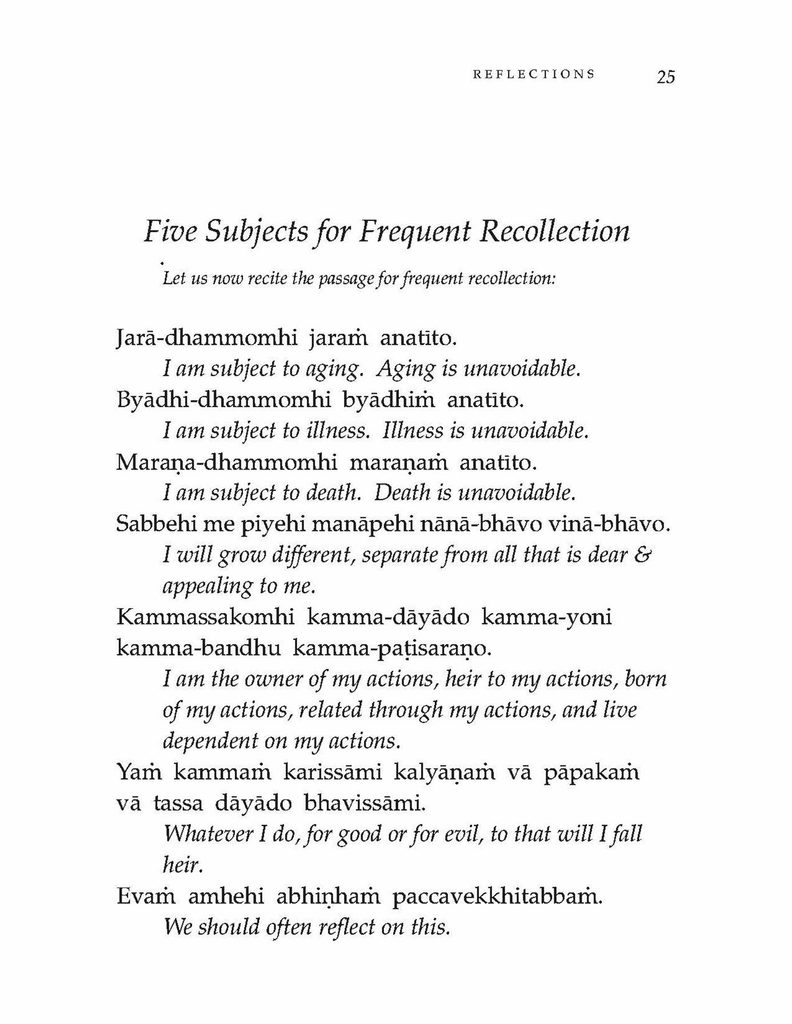
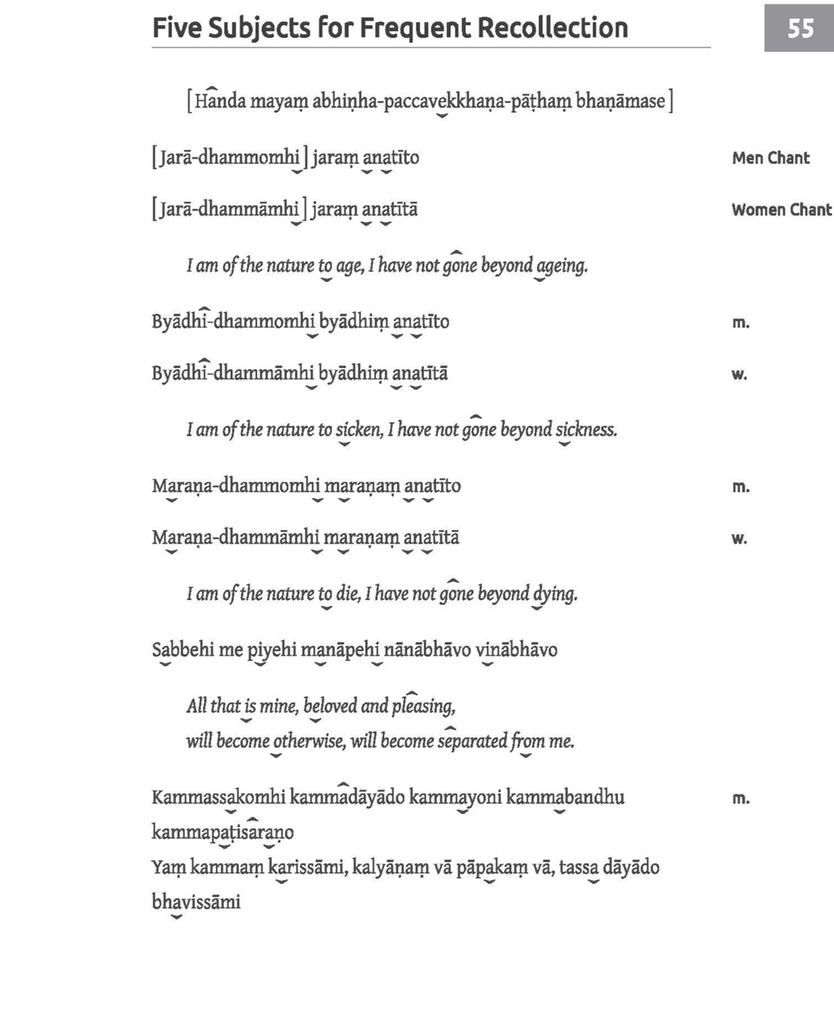
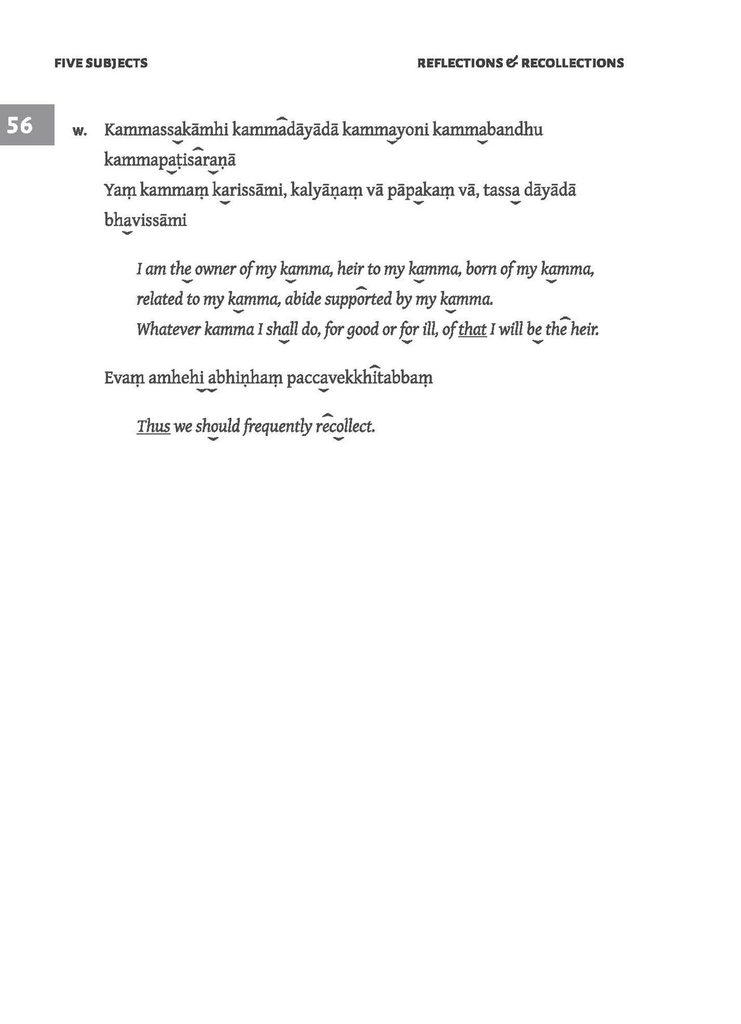
At the beginning or end of your sitting practice, either recite the five remembrances in English or Pali, or read them over slowly.
Three versions are provided at the end of this document. One is from Thich Nhat Hanh, one is from the Dhammayut order of the Theravadan Sangha and includes the Pali, and the third is from Amaravati monastery in England and includes the Pali with intonation marks. It is also the most grammatically correct Pali version, including the variations for different genders. Take your pick!
Reflections for Practice
- In the story of the future Buddha, while still a prince, left the palace and saw the Divine Messengers: a very old person, a sick person, a corpse, and a wandering holy man (samana):
Reflect on the connection between this story and what became the Five Remembrances.
- In the other story that was told last session, Bhaddiya, who, like the Buddha, was also a former prince, rejoiced that as a monk, he no longer had to be guarded or fear for his safety, even though he lived out in the open, meditating in the forest. He was relieved and free from fear. As you have aged, is there something that stands out that you no longer need to be stressed or fearful about?
- We spoke of the four classical stages (Āśramas) of life in Hindu society, which developed about 400 years after the life of the Buddha. It was more of a theoretical structure designed to integrate asceticism into mainstream Hinduism. What would be the stages of your life as you have aged? Originally they were offered as separate choices, without ages assigned. Later they began to be presented as a life journey.
| Stage | Approximate Age | Core Focus & Purpose |
| Brahmacharya (Student) | 0–25 years | Celibacy, education, discipline, and studying under a guru. |
| Gṛhastha (Householder) | 25–50 years | Marriage, raising a family, accumulating wealth ethically, and community duty. |
| Vanaprastha (Forest Dweller) | 50–75 years | Gradual retirement, passing down wisdom, and practicing detachment. |
| Sannyasa (Renunciate) | 75–100 years | Total renunciation of worldly ties to focus exclusively on spiritual freedom. |
Five Remembrances (a version from Thich Nhat Hanh’s Plum Village Chanting Book:
I am of the nature to grow old. There is no way to escape growing old.
I am of the nature to have ill health. There is no way to escape ill health.
I am of the nature to die. There is no way to escape death.
All that is dear to me and everyone I love are of the nature to change. There is no way to escape being separated from them.
My actions are my only true belongings. I cannot escape the consequences of my actions. My actions are the ground upon which I stand.
Session 2 (10/6/2026)
Remember – No session this coming Monday, 10/12/2026
Click here to view or download a PDF version of this home practice with the added readings.
The purpose of the Five Remembrances is to create a practice that keeps bringing us back to certain Dharma truths, which we’d rather not investigate too deeply. We’d prefer not to contemplate or draw too closely to these uncomfortable truths, because of our fear about the future. How will aging appear in our lives? When will we lose our strength and energy?
In Living in the Light of Death, Larry Rosenberg tells the story of the first time that a younger person on the subway got up to offer him a seat. What a blow to the ego! “…I, it seems, looked like a man who needed to sit down!”
(pg. 22).
Personality View
Self- image, called the fetter of “personality view” in the Buddha’s teachings, is a source of suffering when we attach to a fixed view of ourselves in a world where everything is changing. Including ourselves. It’s a form of both greed (we all like the pleasure of feeling good about ourselves) and delusion (our self-image is not necessarily 100% accurate).
In our last session, I mentioned a few times in my life when I needed to adjust my self-image to align with the reality of the physical changes of aging, or acknowledge that I was being viewed differently because I was aging.
Reflection:
Was there a time when the reality of aging became more real for you, and caused you to see that your old self-image had to change?
Asubha practices
Asubha can be translated as “unattractiveness” and appears in practices on the “unattractiveness of the body”. This has nothing to do with conventional societal notions of what’s attractive or not. These practices are designed to help us loosen attachments to physical attractiveness and even our views of the body. The body is certainly miraculous. Even the simple actions of metabolizing energy, breathing, and circulating blood are miraculous. And it’s also true that the attractive plate of food we just enjoyed is less attractive as it becomes partially and then fully digested in the body. You will get a little of the flavor of this attitude in the Dhammapada reading in the PDF resource.
Reflection:
The Five Recollections state that “Aging is unavoidable”. Does knowing that help you appreciate your current abilities, whether physical, such as running or biking, or mental, such as having a good memory? Does it encourage you to feel gratitude for life at this stage?
Practice:
Continue a formal sitting practice from 10-40 minutes each day.
Continue to read or recite the Five Recollections in English and/or in Pali as part of your daily practice. In the readings, I have added intonation marks for the English and Pali versions of one of the chants that we handed out last time.
Session 3 (10/19/26)
Home Practice:
Find the PDF here.
Sit every day for 20-40 minutes
Say or chant and then reflect on any version of the Five Remembrances
Reflect on these study questions:
How can Illness be a teacher?
What have I learned when I’ve needed to rest in bed?
When I fall ill, how attached am I to being able to still be “productive,” or can I easily
allow myself to rest and heal?
In what ways can I understand the Buddha’s Dharma as medicine?
To what degree do I see illness as part of life or as an anomaly?
Do I feel guilty when I get sick?
Notes:
Illness – The Second Remembrance – some reflections
Illness is unavoidable.
This week we are attending the second messenger: illness. We can include in this all sorts
of accidents and injuries that result in the body not being healthy, not just diseases.
“Those not busy being born are busy dying” is a quote from an old Dylan song. The body is
growing, or the body is dying. That’s the way it can feel over the span of our life. We are
young, we grow older, our health and vitality decrease, and then we die, but it’s not really
either growing or dying because the body has been and is currently in a state of constant
change. Many cells die, and many others are born at the same time. The body has about 30
trillion cells in total. 330 billion cells are being replaced every day. (87% of that total are red
blood cells). That’s 3.8 million cells being replaced every second.
We think health is the norm and illness is an anomaly. But you can also see it this way:
illness is an integral and expected part of life. The body has a major system, the immune
system, which evolved millions of years ago to deal with invading bacteria, viruses, and
toxins. Thank goodness it works on its own without “our” need to intervene. We should
maybe look more closely at our illusion of control. We can, of course, take care of hygiene,
eat healthy food, get enough sleep and exercise, manage our stress – and still fall ill.
The question is: when the body becomes afflicted, can the mind be free from affliction?
This brings us to the second arrow: as living beings, we are all subject to painful feelings in
the body and mind. That pain is the first arrow that comes with having a human existence.
The second arrow occurs when we create a ‘me’ that takes the pain on as personal
suffering, leading to worry, self-pity at times, anger, and fear. To prevent the second arrow,
we can see through this process of creating a suffering self. Dharma becomes the
medicine that helps us “see” how to remove the arrow.
In the PDF version of the home practice, I have included the sutta we read in our session,
where the Buddha compares himself to a surgeon summoned to remove the arrow. I’ve
included a second sutta we mentioned where the Buddha talks about the interdependence
of the patient and the caregiver.
Dealing with the difficulty of pain.
By being with physical or emotional pain with mindfulness and compassion, we can help it
heal and pass. Our resistance provides the energy that can allow the pain to persist longer.
The more stability and steadiness of mind that is available in the moment, the easier it will
be to do this. But it’s not always easy. The dharma teaching of impermanence and not-self
reminds us that “This is my experience, but it’s not me. Many others experience this too.
This will pass, as all things do.” In addition to the medicine of Dharma, here are some tips
for dealing with pain.
- Using mindfulness and concentration, awareness can penetrate the pain. See and
touch the pain as if it were a child that we are taking care of. Mindfulness itself is a
form of compassion, because it is a form of acceptance. - Use a neutral object like the breath. It can take a lot of energy to be with pain, but
often there are other non-painful sensations in the body at the same time, that we
can bring awareness to when, out of self-compassion, we need to back off. - Investigate the sensations; notice the “label” of pain. The actual sensations can
often be broken down into stretching, burning, heat, cold, etc. These shift and
change, some decreasing, some increasing. - It can be skillful to direct the attention elsewhere until you can face it.
- This is a training. Start working with small pains. Try to be with them when you are
not in great pain, so that when greater pain arrives, you are better prepared. - Know your energy. Use small gentle efforts. For example: If sitting becomes painful
after ten minutes, try a short sitting of eleven minutes, instead of a long one.
Self-care Seed Thoughts, taken from Ten Thousand Joys & Ten Thousand Sorrows: A Couple’s Journey
Through Alzheimer’s by Olivia Hoblitzelle.
May I cultivate compassion toward myself and others
I trust my ability to handle whatever comes up
May I find new ways of handling my negative emotions
My presence alone is a gift
Let me find ways to bring lightness to our situation
May I stay open, flexible, and caring
I need to take care of myself
Let me practice calm awareness for both of us
May I appreciate our special moments
(Sunakkhatta Sutta, Majjhima Nikāya 105)
Suppose a man were wounded by an arrow thickly smeared with poison, and his friends
and companions, his kinsmen and relatives, brought a surgeon. The surgeon would cut
around the opening of the wound with a knife, then he would probe for the arrow with a
probe, then he would pull out the arrow and would expel the poisonous humour without
leaving a trace of it behind. Knowing that no trace was left behold, he would say: ‘Good
man, the arrow has been pulled out from you; the poisonous humour has been expelled
with no trace left behind, and it is incapable of harming you. Eat only suitable food; do not
eat unsuitable food or else the wound may heal. From time to time wash the wound and
from time to time anoint its opening, so that pus and blood do not cover the opening of the
wound. Do not walk around in the wind and sun or else dust and dirt may infect the opening
of the wound. Take care of your wound, good man, and see to it that the wound heals.’ The
man would think: ‘The arrow has been pulled out from me; the poisonous humour has been
expelled with no trace left behind, and it is incapable of harming me.’
So too, it is possible that some bhikkhu here might think thus: ‘Craving has been called an
arrow by the Buddha; the poisonous humour of ignorance is spread about by desire, lust, and ill will.
That arrow of craving has been pulled out from me; the poisonous humour of ignorance has been expelled. I am one who is completely intent on nibbāna.’ Being one who really is completely intent on nibbāna, he would not
pursue those things unsuitable for one completely intent on nibbāna: He would not pursue:
unsuitable forms with the eye, unsuitable sounds with the ear, unsuitable odors with the
nose, unsuitable flavors with the tongue, unsuitable tangibles with the body, or unsuitable
mind-objects with the mind. Because he does not pursue [these things], lust does not
invade his mind. Because his mind is not invaded by lust, he would not incur death or
deadly suffering.
….
I have given this simile in order to convey a meaning. This is the meaning here: ‘Wound’ is a
term for the six internal bases. ‘Poisonous humour’ is a term for ignorance. ‘Arrow’ is a term
for craving. ‘Probe’ is a term for mindfulness. ‘Knife’ is a term for noble wisdom. ‘Surgeon’ is
a term for the Tathāgata, the Accomplished One, the Fully Enlightened One.
Patient and caregiver – interdependence
(Taken from the sutta “A Monk with Dysentery”). In the story, the Buddha himself takes care
of an ill monk, with help from his attendant Ananda, and he also chides other monks for
failing to attend to him. In this section of the sutta, the Buddha goes on to talk about the
interdependent qualities of a patient and a caregiver.)
(Mahāvagga 8:26)
One who is ill is easy to tend to when they are endowed with these five qualities: one does
what is beneficial; one knows moderation in what is beneficial; one takes medicine; one
makes clear the disease just as it comes to be to one who tends the sick and who wishes
him well, saying as it is getting worse, ‘It is getting worse,’ or as it is getting better, ‘It is
getting better,’ or as it is stable ‘It is stable;’ one becomes the kind of person who endures
arising bodily feelings which are painful, acute, sharp, shooting, disagreeable, miserable,
deadly.
One who tends the sick is fit to tend the sick when they are endowed with these five
qualities: one is competent to provide the medicine; one knows what is beneficial and what
is not beneficial; one takes away what is not beneficial, and brings forward what is
beneficial; one tends the sick with a loving mind (mettā-citta), not in the hope of gain; one
does not loathe to remove excrement or urine or sweat or vomit; one is competent to
gladden, rejoice, rouse, and delight the sick from time to time with dhamma-talk.