
Week 1 (4/22/26)
Satipaṭṭhāna Home Practice Session 1: April 22, 2026
Please click here to download a PDF of this Home Practice and the resources.
I spent some time looking at different translations of the Sutta for our use, and I settled on the one by Anālayo, who I mentioned in class as the scholar-monk who has written several books about this sutta. I recently updated this version to make the language more gender friendly, replacing ‘Monks’ with ‘Yogis’ and ‘he’ with ‘one’. In the conversion process, some formatting was affected, mostly in the loss of diacritical marks for Satipaṭṭhāna. The sutta is in the PDF resource file.
In addition to the translation itself, I am sending you the external link below to the whole book, Satipaṭṭhāna, the Direct Path to Realization, by the scholar-monk Anālayo, which may be too much information! – but it is a good reference. You are not required to read it. This version is the available PDF for free distribution. You are free to download it if you want it or just save the link for later, but be warned that a 300-page book as a PDF is a bit awkward to use.
satipatthana_direct-path_analayo_free-distribution
I will send snippets from this book as we use them.
Sitting Practice:
Try to practice the first section of the sutta, which, as we said, is the same as the first tetrad of the Ānāpānasati Sutta on Mindfulness of Breathing. Here is a short summary of the instructions we used for now.
- Find a quiet place to practice where you won’t be disturbed.
- Take an upright but relaxed posture, using a chair, a cushion, or a bench. Close your eyes if that’s comfortable for you and get a sense of arriving in this space by feeling the body as a whole. Then we will pay attention to the breathing in some different areas.
- In class we used a ‘map’ to bring our attention to these different areas of the body: (1) Below the navel, (2) above the navel and below the sternum, (3) the center of the chest, (4) the throat, and (5) the head at the nose or nasal cavities.
- Spend a few minutes in each area. Feel the actual sensations of breathing as you inhale and exhale. Measure the length of the inhale from its beginning until the end, counting “1,2,3,4,5,6…”
- Let 90 % of your attention be on the sensations of the breath, and 10% be on the counting.
- Adjust the speed of your counting so that a typical inhale is from 5 to 10 counts long. Do the same with the exhale, counting from the beginning of the exhale until the end. Notice the pause between the end of one breath and the beginning of the next inhale, but don’t count until the next inhale starts. At first, the counts may be the same for each cycle of inhale and exhale, because we will often unconsciously try to control the breath. But as we relax, the breath will start to vary. Some inhales may be just 5 counts. Other inhales may be 7 or 8 counts. We don’t care how long each breath is. We just want to pay close enough attention to notice a natural variation. Some breaths are longer, and some are shorter.
- The counting uses the linguistic part of our brain to gather the attention around the breathing and helps ‘seclude’ us from our day-to-day thinking.
After a few minutes in each of the five locations in this map, please drop the counting and consider transitioning to silently saying a meditation word or phrase with each inhale and exhale. Some common ones that are used are:
- “In” and “Out”
- Inhaling, arriving home to the present moment” (which becomes abbreviated to “Arriving”)
- Exhaling, I know it is a wonderful moment” (which becomes abbreviated to “Wonderful moment”)
- “Buddho”, which is a version of “Buddha”. Buddho means “The one who knows” and is used by saying “Bud” on the inhale and “dho” on the exhale.
This covers the first two steps which are:
- “The yogi breathes in knowing “breathing in long”; the yogi breathes out, knowing “breathing out long.”
- “The yogi breathes in knowing “breathing in short”; the yogi breathes out, knowing “breathing out short.”
The next two steps are:
- “The yogi breathes in, sensitive to the whole body; the yogi breathes out, sensitive to the whole body.”
- “The yogi breathes in, calming the body formations; the yogi breathes out, calming the body formations.” Formations here are anything that makes up the physical body: muscles, bone, connective tissue, organs, blood vessels, etc.
We have already started to do this by bringing attention to different body locations on our map. See if you can get a sense of being aware of more of the body at once. Let the breathing show you where there is tightness in the body. The awareness itself will encourage the body to relax without forcing anything to happen. Enjoy this practice. Smile. Each inhale is a moment of nourishment, and each exhale is a letting go. Finish up with a sense of being present to the whole body, relaxed. Don’t struggle.
The end point of this first practice is to allow the body to relax and the breath energy to flow, while we begin to calm the mind, coming to what is called “full body breath awareness”.
Walking Practice:
For this practice, walk at a normal speed. Use the Thich Nhat Hanh method of counting how many steps for an inhalation and how many for an exhalation. Just as in the sitting, you can drop the counting whenever you want and just be present with the walking.
- Check in with some or all of the Four Foundations throughout the day, by just occasionally pausing to ask, “How is my body now?”, “How are my reactions (feeling tone) to this moment; am I liking or not liking it?”, “How is my awareness (mind) focused or distracted, sharp or dull, narrow or spacious, colored by a mood or not?” and what mind-states, thoughts and emotions (contents of mind, or phenomena) are coming and going?
Week 2 (4/29/26)
Satipaṭṭhāna Home Practice Session 2: April 29, 2026
Click here for a PDF of this practice and any resources.
In session 2, we covered the next two paragraphs of the sutta and also discussed the “definition” of working mindfully with the four Satipaṭṭhāna. We also discussed the repeating section of the sutta called the “refrain” that comes after each paragraph of instructions.
(‘definition’ and ‘refrain’ are Anālayo’s classifications). Note: this is for your information only. You don’t have to memorize this. If this is too many words, skip to the practice section.
As a reminder, the sutta starts out with a declaration of the ‘direct path” and the definition:
[DIRECT PATH]
“Monks, this is the direct path for the purification of beings, for the surmounting of sorrow and lamentation, for the disappearance of dukkha and discontent, for acquiring the true method, for the realization of Nibbana, namely, the four Satipaṭṭhāna.”
[DEFINITION]
“What are the four? Here, monks, in regard to the body, a monk abides contemplating the body, diligent, clearly knowing, and mindful, free from desires and discontent in regard to the world. In regard to feelings, he abides contemplating feelings, is diligent, clearly knowing, and mindful, free from desires and discontent in regard to the world. In regard to the mind, he abides contemplating the mind, diligent, clearly knowing, and mindful, free from desires and discontent in regard to the world. In regard to dhammas, he abides contemplating dhammas, diligent, clearly knowing, and mindful, free from desires and discontent in regard to the world.
The definition is the same definition as stated in the sermon on the eight-fold path, for “right mindfulness”
According to Anālayo
Diligent, (ātāpi) – means putting some energy into meeting the present moment with sustained interest
Clearly knowing (sampajañña)– means seeing the object of awareness unfiltered, with all its characteristics, especially the qualities of impermanence, imperfection, and not-self.
Mindful (sati) is not just being conscious but remembering to come to the present moment repeatedly with open receptivity.
“Free from desires and discontent with regard to the world” means to put aside our everyday thoughts as we practice, so many of which are made up of our wanting and not wanting.
[REFRAIN]
In this way, in regard to the body, she abides contemplating the body internally, or she abides contemplating the body externally, or she abides contemplating the body both internally and externally. She abides contemplating the nature of arising in the body, or she abides contemplating the nature of passing away in the body, or she abides contemplating the nature of both arising and passing away in the body. Mindfulness that ‘there is a body’ is established in her to the extent necessary for bare knowledge and continuous mindfulness. And she abides independent, not clinging to anything in the world. That is how, in regard to the body, she abides contemplating the body.
Internally means within one’s own experience.
Externally means what is learned from observing others
Aware of arising and passing away
Just being aware for the sake of building continuity and momentum in mindfulness.
Independent of clinging.
Continuous mindfulness builds momentum and concentration. Think of concentration as being like a tincture, filtered and slowly purified, rather than being like a laser beam, intensely focused. Leading to the “clear seeing” of insight. See the “purposes of mindfulness” from Thich Nhat Hanh in the resources.
The [REFRAIN] is repeated after each section in the Sutta. Remember that at the time of the Buddha, none of the suttas were written down, as it was an oral tradition. Suttas were chanted and included a lot of repetition, to help the monks and nuns remember them.
Practices:
Use mindfulness phrases or gathas, as they are called in the Vietnamese Buddhist tradition, to connect with the body in daily life. Here are some suggestions
- Body Positions
- Start with the phrase from the refrain, “There is a body”, then note the position of the body:
- standing, sitting, walking, and lying down. These are the ‘classic’ positions mentioned in the text, but the text really means all positions, so you can add bending, stretching, twisting, squatting, in short, anything that describes the position of the body. If you want, shorten the phrase to just: “the body is standing” or just name the position itself, “sitting.” Don’t tire yourself out by doing this all day; instead, try it for a period of time, maybe 20 minutes, as practice.
- Notice how you move from lying down to sitting on the bed to standing up to walking to the bathroom every time you get up in the morning. Notice these transitions in your positions throughout the day.
- Start with the phrase from the refrain, “There is a body”, then note the position of the body:
- Body Activities
- Use noting to label activities for a period of time: putting food in my mouth, chewing, tasting, swallowing, washing a dish, rinsing a glass, walking, buttoning my shirt, adjusting the rearview mirror, waiting for the dog, sitting on the toilet, looking at the clouds.
- Try to stay with the physical aspect of the activity (including what is coming through the senses), rather than your emotional reaction to the activity. That comes later!.
- Continue to practice formally, sitting and/or walking for at least 20 minutes daily using the first instructions on mindfulness of breathing. Walking meditation, slow or fast, is naturally compatible with noticing bodily positions and activities, and “walking” is one of the positions.
Enjoy practicing!
Week 3 (5/6/26)
Satipaṭṭhāna Session 3: May 6, 2026
Please click here for a PDF of this home practice.
Resources:
- There is a link below to the Ajahn Sucitto book that we’ve mentioned.
- The other resource this week is a guided standing practice, (which is an audio (mp3), taken from the book.
Review
In this session, we continued working on the first Satipaṭṭhāna of Mindfulness of the Body. The first three sections of mindfulness of the body help us be more mindful ‘internally’ from a sense of embodiment. The body feels like ‘this’ as I breathe, change postures, and engage in the Activities of Daily Living. Awareness of Breathing is usually a formal sitting practice, but the breath can also serve as an anchor, reminding us to be present in our daily activities and sustaining the momentum and continuity of mindful attention. As we practice, we may want to choose certain activities as special opportunities to be present, such as taking a shower, preparing food, or eating. We explored the postures of lying down and standing.
This is an excerpt from Ajahn Suchitto’s book, “Standing on Your Own Two Feet”.
‘Standing on your own two feet.’ Think about it: stability, confidence, simple dignity. The phrase is used as a metaphor, but it’s more than that. If you want to get a break from a scattered mind and stressful moods, it could be as easy as literally standing on your own two feet. Furthermore, if you’d like to meditate, but feel challenged by the idea of sitting still with nothing to do for more than five minutes… some standing could be a manageable way to get started on the road to inner balance. It gets you grounded. And if you already do like to meditate, standing could be a way to relieve some bodily discomfort and widen your practice in unexpected but effective ways. I’m certainly not against seated meditation – it’s just that the seated form presents issues in terms of discomfort and through its passivity. The discomfort in the knees and back for bodies that have become used to, and even shaped by, sitting in chairs commonly distracts attention from settling and clearing the mind. On the other hand, if you do get comfortable, it’s easy then to drift into thoughts and daydreams. Then meditation becomes a tedious process of repeatedly trying to establish a focus. Also, with sitting, your weight rests on your bottom and your thighs – which are not designed to be sensitive to the ground, nor are they required to maintain balance. When seated, the feet and the knees – those parts of your body that help you to feel grounded and balanced – are switched off. With standing however, the body automatically focuses on establishing groundedness and balance: your feet and legs come into alignment with the spine in a relaxed but alert way. And that of course affects your mind. It relaxes the mind while encouraging attentiveness to how the body stands as an interconnected system. Therefore, your mind comes out of its preoccupations and also isn’t easily invaded by what’s going on around you. Because of all this, fifteen minutes or more of standing can be a useful prelude to a period of sitting meditation, or a clarifying practice in its own right. Because standing fast-tracks balance, connectivity and wholeness, it’s useful to practice this in any ‘pause moments’ in the day.
Here is the link to get your own free ebook version. This is optional, but suggested, reading:
Home Practice
- Continue using the map of the breath centers, and the counting for the few minutes of your daily sitting.
- Keep working with the practices we’ve covered, with an emphasis on bodily postures and activities in daily life. Can they become as much a part of your practice as sitting and walking meditation?
- Do you relate to the quality of “groundedness”? What does it mean to be grounded in any given posture?
- For a few breaths, try turning your awareness to your feet, and the feeling of standing, when you find yourself in an activity that you normally do when standing such as: washing dishes, cooking, waiting for the subway, in the checkout line at the store, etc.
Week 4 (5/13/26)
Satipaṭṭhāna Sutta Session 4 Home Practice 5-13-2026
Click here for a downloadable PDF copy of this home practice.
The three Satipaṭṭhāna practices with the body that we covered this week: – awareness of anatomical parts, the elemental characteristics of the body (earth, water, fire, and air), and corpse contemplations- are specifically designed to shift our perspective on the body. They aim to reduce our attachment to the body as ‘me’ or ‘mine’, and to view it simply as nature, subject to the laws of arising and passing away. These practices can potentially transform our relationship with our bodies, inspiring us to see them in a new light.
The first two of these can be practiced during a body scan, attending to each part of the body as we scan through with our awareness. Anatomical parts can be practiced outside of formal sitting by just taking an interest in anatomy itself. Even our intellectual knowledge of the body can help our practice. Is my artificial hip still “me”? How about the titanium rod in my back? Or the fillings in my teeth? When did the fillings become me? In traditional Buddhist practice, the monastics contemplated 32 parts of the body. With the benefit of even a high school biology book, we could probably identify 32 parts of a single cell. The key is bringing your “Dharma glasses” to your knowledge of the body and its workings. It’s a beautifully functioning set of interconnected systems when it’s healthy; but whether healthy or not, it’s ‘not me or mine’, It is subject to change and age in ways that ‘we’ can’t control, and there are also natural body fluids and odors that we are repulsed by.
The body’s elemental qualities allow us to notice solidity, cohesion, and flow; warmth and coolness; and internal and external energy. I have added a reading on the elements from Ajahn Sucitto as a resource at the end.
The corpse contemplations drive home how the body, step by step, will return to dust. For the corpse contemplations, I suggest that, as you are on a walk, bring awareness to any dead animals you see. Most often, that will probably be roadkill. How long has this squirrel, rabbit, or other animal been dead on the road? If you see a fresh animal carcass, do you feel repelled? How about if there is only a small patch of fur left, the same reaction? Imagine the animal in all its aliveness, right before it was killed. All living creatures, ourselves included, will die, as death is unavoidable, and the moment of our death is unknown.
Practices:
- As you do your sitting, standing or lying down meditation this week, be sure to start, as we normally do anyway, by feeling the solidity of the “earth element” of the body: How the body is supported in space and how the gravity of the earth continues to connect us to the earth. You might then connect to the other elements of flowing breath and energy and notice warmth and coolness.
- Use your imagination to play with our views of the body: Imagine you are 100 years old and you are looking at yourself in the mirror. What has changed? Imagine someone you are physically attracted to , with transparent skin, and organs, where you can see every internal organ, the blood, bodily fluids, and waste products. How does that change their attractiveness?
- Spend some time with an anatomy book. Look at the pictures as being you. You are like this. You have this collection of parts and systems. If you don’t have a book handy, there are several free websites. I am not endorsing any particular one, but you can get a free starter account at this one: www.biodigital.com
- Maintain awareness throughout the day, tuning in frequently to the feeling of the body as it moves through postures and activities. Relax tension in the body whenever you are aware of it. Enjoy having a body.
ELEMENTS – from the Ajahn Sucitto book, On Your Own Two Feet, the chapter on “Harmony”
ELEMENTS
You can follow a fine-detailed way into this state of harmony by
referring to very basic qualities that determine how things, internal
and external, appear. They’re called ‘elements’ (dhātu). There are four
primary elements and two secondary or mediating elements.
The primary elements are earth, water, fire and air.
Earth refers to anything that feels solid, holds a form, is static and resists pressure.
Water is the element that is experienced as fluid, and changeable, has no fixed boundaries, and merges with whatever it contacts. It dissolves differences.
Fire is the quality of heat and vitality; it lights things up.
Air is the element associated with movement; it penetrates and pushes.
You can experience these qualities in the land, rivers, sunlight and wind.
And you can also experience these in the firmness, fluidity, vitality and breathing of your body.
At a psychological level, we have the same qualities: we can be firm, flexible, bright, and breezy. Ideally, these elements balance each other; then the result is harmony. On the other hand, when harmony is lost, our firm earth gets rigid, or we get watery and indecisive, hotheaded,
or blustery. In this case, one element dominates and isn’t
balanced by the other three.
Air loses contact with earth and we get blown away. The fire of our enthusiasm isn’t moderated by the cool water of including the whole picture (and other people), and so on. Worse still, personality habits develop around that imbalance: we may err towards being fiery and righteous, or stodgy and inflexible. You might know people in whom the water element is so dominant that decision-making is difficult; and there are those who blow this way and that and never settle. A balanced person, however, isn’t distinctly any of these; in them, the elements blend into unity.
As I’ve suggested, in terms of energy, body, heart and mind are not separate: a fiery heart inflames the body; a depressed mental state muddies and constricts bodily energy. But when the elements are in balance, they correct these conditions. Accordingly, in standing meditation we detect and work on these elements, through mediating them in the presence of the secondary elements of space and consciousness. I’ve mentioned space before; it’s a quality that, although essential, is easily overlooked. When we are fully aware of it, it’s the openness that allows experience.
Space reduces pressure and allows stuck energy to settle and flow. If we detect this open absence of pressure and extend awareness from it to any other element, space moderates the imbalance that makes earth rigid, water abysmal, fire blazing and air restless. When this effect is felt and transfers to the heart, then the reflexes of defensiveness, apathy, aggression/frustration and agitation are transmuted into more balanced emotional forms.
Consciousness is equally crucial. In this respect, ‘consciousness’ is the location of awareness at any given moment. By default, it locates awareness within a field of sights, sounds, smells, tastes, touches and ideas, with its mental aspect stitching the varying sense impressions together to form a known object. Obviously seeing an apple is nothing like tasting an apple (and perhaps not quite as we imagine it would be), but mental consciousness spreads over and combines these impressions to make up the knowable ‘apple’, then taps the ‘agreeable/disagreeable’ button on the heart. Thus aroused, heart-energy shifts, recoils or (rarely) suffuses awareness – and we experience an apple that we like the look of, and eat (or not).
Week 5 (5/20/26)
Satipaṭṭhāna Sutta Session 5 Home Practice 5-20-2026
Click here for a downloadable PDF copy of this home practice.
In this last session five, we looked at the second Satipaṭṭhāna of vedanā. Vedanā is sometimes translated as “feeling,” but more accurately as “feeling tone.” In other words, it’s not feeling as ‘emotions’ nor is it sense sensations, but rather it is the immediate reaction to our experience; the seeds of emotions, in terms of “This is pleasant” or “This is unpleasant”, or “This is neither pleasant nor unpleasant. Those feelings that we would say are neither pleasant nor unpleasant are identified as “neutral”.
Vedanā are low-level components of experience. They happen immediately after the senses contact a sense object. They are very important, though. As the Buddha taught in his teaching of Dependent Origination, which describes how we come to cling to and identify with our experiences, vedanā is a weak link in that chain. By seeing clearly whether an experience is pleasant or unpleasant, we can be prepared for the fact that a pleasant experience can lead to clinging, and an unpleasant experience can lead to aversion or hatred. Neutral vedanā lead to delusion or confusion about what we are experiencing or to just ignoring it. Because vedanā arises and passes so quickly, they are also perfect for observing and gaining insight into the nature of impermanence. Mindfulness of vedanā is a beautiful tool for exploring causation as well. The vedanā are the seeds of what grow into a complete emotional reaction.
It is becoming more evident as we move through the four Satipaṭṭhāna that these different realms of experience are not separate but come together and influence each other. For example, let’s say you hold the view, (foundation four) based on your past experiences of eating, that you do not like cauliflower. If you walk into a room where someone is cooking cauliflower, your first experiences would likely come through the sense of smell (body, foundation one). The initial vedanā(second foundation) might be neutral if it’s actually the taste of cauliflower that you don’t like rather than the smell. Then as perception kicks in, (foundation four, one of the aggregates ) and you recognize that the aroma is coming from that particular vegetable, then your unpleasant memory of past experience (a mental fabrication from the fourth foundation of mindfulness) causes unpleasantness to arise which is a new unpleasant vedanā coming from the mental experience of the memory. The unpleasant memory may influence the neutral vedanā that initially came from your first whiff of the aroma of cooking, so that now when you smell cauliflower cooking, an unpleasant vedanā arises from just the recognition of the aroma itself! I have to laugh at myself as I read this back. It sounds so complicated! It’s not really. Just think of Vedana as our initial reaction to experience.
Worldly and Unworldly Vedanā
In the two paragraphs that describe this second satipaṭṭhāna, the Buddha says that the yogi knows a feeling to be a (pleasant, unpleasant, or neutral) worldly feeling or a (pleasant, unpleasant, or neutral) unworldly feeling.
I have found the best explanation of “worldly” and “unworldly” to come from Joseph Goldstein’s book, Mindfulness: A Practical Guide to Awakening.
Joseph explains that worldly vedanā are directly related to the senses. So a pleasant sight, sound, taste, smell, physical sensation, or mental/emotional input triggers pleasant worldly feeling tones; likewise for unpleasant and neutral sensations.
An unworldly feeling tone generally comes as a fruit of practice, particularly as a result of renunciation. The indented sections below contain some quotes about unworldly pleasant vedanā from Joseph’s book. These are examples of where we experience unwordly happiness in daily life or in formal practice:
In our Western cultures, the idea of renunciation doesn’t always inspire us. We tend to think of it as deprivation, something that might be good for us in the end, but is not that much fun now. But another way of understanding renunciation is as nonaddictiveness to sense pleasures. From this perspective, renunciation holds out the possibility of happiness now. The less addicted we are to the seduction of sense pleasures, the less commotion there is in the mind. We experience greater ease and simplicity of living. Imagine what it would be like if the mind wanted everything that was advertised on television. We would be in a constant state of dis-ease, wanting this, wanting that. I think this is why we all prefer commercial-free programming. In the words of one Tibetan teacher, we learn to rest our weary minds. The Buddha highlighted this understanding when he said, “What the world calls happiness, I call suffering; what the world calls suffering, I call happiness.”
Generosity
…[we] do experience clear times of nonsensual joy, the unworldly pleasant feelings. We experience them in times of generosity, when we are renouncing mind states of greed and stinginess. Think of times when you were generous with someone, giving something out of love or compassion, respect or gratitude. Practicing generosity is an easily accessible gateway to the happy, unworldly feelings based on renunciation, and it is the reason the Buddha usually begins his progressive teachings speaking of generosity.
Love and Compassion
We feel nonsensual joy when we practice qualities like love and compassion. …Sometimes we see the best qualities of humanity emerge in times of great disasters, where there is an outpouring of generosity from people all over the world. We can feel the purity of those mind states. People aren’t giving in order to get anything back for themselves, and they are often moved to give more than they might have under more normal circumstances. In this response to suffering, there is the purity of a spontaneous, compassionate response, which brings its own kind of happiness.
Renunciation associated with morality.
We feel a nonsensual joy when we practice the renunciation involved with following the precepts. We renounce harmful actions, and this renunciation brings the unworldly pleasant feeling of nonremorse. And even if we’ve done unskillful actions in the past—as we all have—there is a certain strength and confidence and happiness from the moment we make the commitment to nonharming.
Renunciation of voluntary simplicity.
We feel pleasant unworldly feelings on retreat, in the renunciation of our familiar comforts. We begin to enjoy the beauty of simplicity.
Renunciation born of seclusion from the hindrances, leading to concentration.
We experience the nonsensual joy of unworldly pleasant feelings in states of concentration, where the mind is secluded from unskillful states. At first our minds are often restless and agitated, jumping from one thing to another, reacting to the various pleasant and unpleasant feelings that arise. At a certain point, whether for short periods or sustained ones, the mind settles down, resting easily on the object of attention, carried on the current of mindfulness. There is an ease and pleasure here much greater than that of our usual sense delights. There’s a greater sense of unification.
Unworldly joy, born of wisdom and “clearly seeing” the nature of things.
We experience an even higher nonsensual joy in the various stages of insight and awakening. Here it is not the absorption in the unworldly pleasant feelings of concentration, but the special happiness of clear seeing — that is, seeing deeply and vividly the changing, selfless nature of all that arises. And as insight practice matures in various ways, there is an even more refined kind of happiness.
———————-
We’ll close by just touching on unworldly unpleasant and unworldly neutral feeling tones. An unworldly, unpleasant feeling tone may arise, for example, during meditation practice, as locked-up sorrow or anger is released. Regarding neutral feeling tones, worldly neutral feeling tones often arise from the perceived blandness of the object. The objects are not stimulating or interesting enough to be felt as pleasant. Unworldly neutral vedanā can be a result of what is considered wholesome “dispassion” or “disenchantment”, and may mature to become equanimity.
Practice
- During a sitting or walking practice, just label each experience as pleasant or unpleasant for part of that practice time. After you get the hang of it you can add a neutral label. Vedana arise quickly, so don’t try to follow each one. For example, if your mind wanders to a memory, note if that is a pleasant or unpleasant memory before you return to your anchor. If you are irritated that your mind wandered, label that irritation unpleasant. If a sensation in the body or from the senses comes into awareness, can you label that?
- Consider keeping a pleasant event and unpleasant event log this week. This will be less detailed than what you do during meditation, focusing on daily events, like a phone call, a task, an email, a conversation, an experience of hunger, or of being too cool or too warm. You could list pleasant events on one day and unpleasant events on another. You could keep a running list or just reflect back at the end of the day in a journal. Which list is longer? According to the discussion above, did you notice any unworldly pleasant vedanā?
Week 6 (5/27/26)
Satipaṭṭhāna Sutta Session 6 Home Practice 5-27-2026
Click here for a downloadable PDF copy of this home practice.
Third Foundation: Mindfulness of Mind
Here is the first part of the instructions for being mindful of the mind:
Here one knows a lustful mind to be ‘lustful,’ and a mind without lust to be ‘without lust.’ One knows an angry mind to be ‘angry,’ and a mind without anger to be ‘without anger.’ One knows a deluded mind to be ‘deluded,’ and a mind without delusion to be ‘without delusion’; one knows a contracted mind to be ‘contracted,’ and a distracted mind to be ‘distracted.’
Notice that what the Buddha asks us to do is very specific. This Satipaṭṭhāna instruction starts out asking us to be aware of either the presence or absence in the mind of what are called “the three unwholesome roots” of greed, hatred, and delusion, known as a group in Pali as the kilesas. They are also referred to as the three defilements, three poisons, or the three afflictions. The instruction is to just be aware of their presence or absence. This can be hard in a Western culture where we tend to want to fix something or add on something extra to our commentary, for example: “This is anger, and I shouldn’t be feeling anger”, which of course is aversion of aversion. We end up in an unhelpful cycle of self-judgment.
These obscurations of the natural purity of awareness can be obvious or quite subtle. In Joseph Goldstein’s book, Mindfulness, a Practical Guide to Awakening, he suggests that some questions can be very helpful.
The first question might be “What’s the attitude in the mind right now?” This can put us in touch with the presence or absence of the three unwholesome roots. (By the way, they are called unwholesome because when acted upon, they can lead to harmful speech or action, or to confusion.) Joseph says, “Often just in asking the question, we can feel the mind relax from a clinging or aversion we hadn’t even realized was there”.
It can be more difficult to notice the absence of an unwholesome root in the mind. Our built-in negativity bias keeps on the lookout for what’s not right. But by noticing the absence or the impermanent nature of these mind states, the Buddha points out that they are visiting states of mind, they are not who we are.
“Luminous, bhikkhus, is this mind, but it is defiled by adventitious defilements. The uninstructed worldling does not understand this as it really is; therefore I say that for the uninstructed worldling there is no development of the mind. “Luminous, bhikkhus, is this mind, and it is freed from adventitious defilements. The instructed noble disciple understands this as it really is; therefore, I say that for the instructed noble disciple there is development of the mind.”
The next instructions have to do with whether there is enough energy in the mind for it to connect and be present with our experience, or if low energy is making the mind withdraw and contract. The opposite of this is a mind where the energy is unsettled, easily distracted, and restless.
one knows a contracted mind to be ‘contracted’, and a distracted mind to be ‘distracted’
When you look at these states so far, altogether, they align with the list of ‘hindrances’. Sensual desire (lust), Anger (ill-will or aversion), contracted mind (sloth/torpor), distracted mind (restlessness and worry), and deluded mind (doubt). The next practice question, which is particularly helpful when we don’t know why we are struggling, is: “What is happening?” We may find that one of these states is present but not acknowledged. Again, these hindrances may only exist as a subtle background mood throughout our day. Even then, recognizing there is an aversion to ‘not knowing’ why I feel blah or uninspired, can relieve some of the struggle, in this case, of aversion.
The next set of qualities listed in the sutta have to do with concentration and the qualities of awareness.
One knows a great mind to be ‘great’, and a narrow mind to be ‘narrow’; one knows a surpassable mind to be ‘surpassable’, and an unsurpassable mind to be ‘unsurpassable’; one knows a concentrated mind to be ‘concentrated’, and an unconcentrated mind to be ‘unconcentrated’
About this, Joseph says:
Great and narrow refer to how far the concentration pervades. For example, in the brahmavihāra practices of love and compassion, they refer to whether we are radiating these feelings toward all beings or just one person. Surpassable and unsurpassable refer to the level of absorption and whether the higher levels are attainable or not. … The third pair, concentrated and unconcentrated, emphasizes being mindful of whether stable one-pointedness in both samatha (concentration) and vipassanā (insight) meditation is present or not.
The last part of the instruction in this third Satipaṭṭhāna is:
One knows a liberated mind to be ‘liberated’, and an unliberated mind to be ‘unliberated.’
While this could refer to complete liberation, a full awakening, the more practical aspect of this instruction is to notice the small moments of ease when we are not being bound by desire, or the aversions of fear or irritation.
Practices:
- Practice checking in, throughout the day, or during formal practice using one of the two practice questions: What is my attitude right now? Or What is happening right now?
- When there is a strong aversion or a strong desire that rises up in the mind, see if you can stay with it for its duration. Can you see it start to fade? Can you feel what the mind and body are like after it has passed? Try working with a desire where you take no action to satisfy the urge. For example, you felt like taking a nap, but you didn’t do it. This is called “urge surfing”. If it feels too hard to stay with it the whole time, set a reminder to check in later. What does the cessation of that desire feel like?
- Review the part that occurs after each section in the sutta that Anālayo calls “The Refrain”. What does it mean when we apply it to the Satipaṭṭhāna of the mind? What does “One abides contemplating the nature of arising … of passing away … of both arising and passing away in regard to the mind” mean? What does it mean to establish bare attention in the mind? And to abide independent, not clinging to anything in the world?
Week 7 (6/3/26)
Satipaṭṭhāna Session 7 Home Practice 6-3-2026
Click here to download a PDF of this home practice
The Fourth Foundation of Mindfulness: dhammas
The word dhamma in Pali is usually written in lowercase to distinguish it from the body of the Buddha’s teachings, also called Dhamma (Dharma in Sanskrit). Dhamma also means the ultimate reality of things as they are. Lower-case dhamma is typically written as the plural dhammas and has been translated in several ways. “Mental objects” and “phenomena” are two of the most common translations. Anālayo says this is not a great translation, since we’ve already been looking at mental objects in the previous tetrads. For now, though, as we read the sutta, we can notice that there is a fundamental difference between the fourth foundation and the previous three. While the other three Satipaṭṭhāna indicate ‘things’ to be mindful of, the fourth, as listed in the usual Pali translations, is a set of lists: the hindrances, the aggregates, the sense spheres, the seven awakening factors, and the four noble truths.
Anālayo suggests that these lists in the fourth foundation are like lenses we use to view the phenomena of our experience. His comparative investigations of other texts revealed that most Chinese versions of this sutta and several later Sanskrit versions do not contain all the lists but instead include only two: the Five Hindrances and the Seven Factors of Enlightenment.
This makes sense considering how we practiced the previous foundations and allows the fourth foundation to function as a natural progression from the third. In the third foundation, we looked at the mind, particularly identifying the presence of unwholesome or unskillful mind states and contrasting that to knowing when wholesome or skillful mind states were present.
The instructions for the fourth foundation instruct us to abandon the unwholesome states, as defined by the hindrances, and to encourage and support the wholesome states, as defined by the seven factors of enlightenment. This quote from Anālayo’s translation of the sutta illustrates that contemplating ‘dhammas’ in this context means more than merely noting the presence or absence of a mental state; it’s about getting to know them.
The instructions for contemplating the hindrances are as follows:
If sensual desire is present in him, he knows “there is sensual desire in me.”; If sensual desire is not present in him, he knows “there is no sensual desire in me”; and he knows how unarisen sensual desire can arise, how arisen sensual desire can be removed, and how a future arising of the removed sensual desire can be prevented. If aversion is present in him, he knows… If sloth-and-torpor is present in him, he knows… If restlessness-and-worry is present in him, he knows… If doubt is present in him, he knows “there is doubt in me”; if doubt is not present in him, he knows “there is no doubt in me”; and he knows how unarisen doubt can arise, how arisen doubt can be removed, and how a future arising of the removed doubt can be prevented.
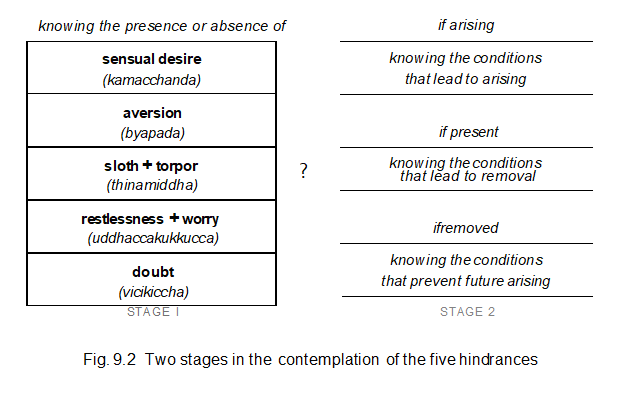
In other words, it’s not just recognizing that a state like aversion is present or absent. The instructions ask us to investigate all aspects of that state, understanding how it can arise, how it can be removed, and how a future arising of the state can be prevented.
Why start with the hindrances?
Without recognizing them, the hindrances cloud the mind, block wise discernment, stunt concentration, and obscure the realization of the Four Noble Truths. To make progress, a traveler must first understand what is blocking the path.
The Pool of Water Simile (Obscured Perception)
In ancient times, a bowl of water was used as a mirror. This simile likens the different hindrances to various conditions that disturb the water and prevent it from clearly reflecting things as they are.
- Sense Desire: Like clear water suffused with a colored dye (colors and distorts perceptions).
- Aversion: Like boiling water (causes turbulence; impossible to see through).
- Sloth and Torpor: Like a pool overgrown with algae (stagnant and murky).
- Restlessness and Worry: Like water whipped up by the wind (agitated and tossed around).
- Doubt: Like muddy water (obscures the bottom completely).
Another famous simile likens the hindrances to a certain human condition, for example, being in financial debt, being ill, being in prison, being in slavery, and being lost in the desert; while being free from a hindrance is like having a debt paid off, recovering from illness, being released from prison, being freed from slavery, and arriving at a safe destination.
Practices
Become familiar with the five steps (see below) of working with a hindrance.
- Work on the first steps, knowing whether a hindrance is present or absent. We sometimes take the absence for granted, so take a moment to notice what it feels like to “feel out of debt” after the hindrance has passed.
- Integrate the five-step practice with what we have done before, when working with the mindfulness foundation three, mindfulness of mind. Knowing, for example, the mind that has lust or anger, and one that is free from lust or anger.
- Continue your daily sitting. Practice with the hindrances both on the cushion and in daily life.
- Enjoy your practice
Working with the Hindrances
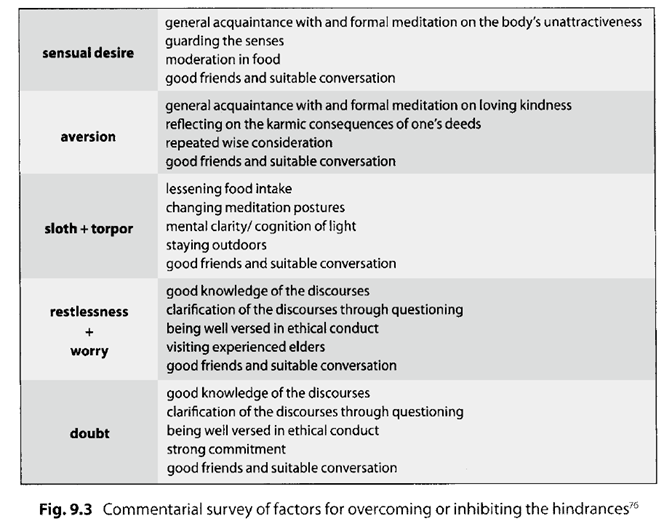
As stated in the sutta, there are five steps to working with each hindrance. Here is an example, based on Joseph Goldstein’s book, Mindfulness: A Practical Guide to Awakening. Working with the hindrance of desire:
- Step 1: Recognize Desire When It Is Present
- Acknowledging the “wanting mind” without judgment.
- Can range from massive obsessive passions/addictions to small passing whims.
- In meditation, it often shows up as the “in-order-to” mind (e.g., watching a pain in order to make it disappear).
- Step 2: Know When Desire Is Absent
- Actively noticing the “luminous mind” when it is temporarily free of grasping.
- Builds genuine confidence and faith in the practice because the relief of being “out of debt” is felt directly.
- Step 3: Know the Conditions Underlying Its Presence
- Lack of mindfulness at the sense doors: Getting caught in sensory triggers (e.g., food in a retreat lunch line, or a “Vipassanā romance” when looking at an attractive person).
- Repetitive thought patterns: As the Buddha stated, whatever the mind frequently ponders becomes its default inclination.
- The fundamental misperception: The false belief that temporary things yield lasting happiness.
- The Modern Challenge: Countering a commercial culture that screams at individuals to “increase your desire.”
- Step 4: Know the Conditions Underlying Its Removal
- Clear recognition: Using the psychological frame “Desire, I see you” strips the hindrance of its automated power.
- Wise reflection: Deploying an “internal Dharma coach” to remember one’s primary intention—to remain trapped or to be free.
- Step 5: Avoid Future Arisings
- Proactive mental healthcare (e.g., contemplating the unattractive or aging nature of the body to counteract physical obsession).
- Guarding the sense doors at the exact moment of initial sensory contact.
- Practicing moderation in food and surrounding oneself with wise friends.
Here are two illustrations from Anālayo’s book, Satipatthana, The Direct Path to Realization, that illustrate the five steps, and suggestions from the commentaries on overcoming them.
Week 8
Satipaṭṭhāna Sutta Session 8 Home Practice 6-10-2026
Click here for a downloadable PDF copy of this home practice.
The Fourth Foundation of Mindfulness: dhammas (continued from session 7)
In session 7, we mentioned that in this practice group we are covering only two of the five sets of dhammas, or mind objects, listed in the complete sutta. Last time, we covered the hindrances and talked about:
“If sensual desire is present in him, he knows “there is sensual desire in me.”; If sensual desire is not present in him, he knows “there is no sensual desire in me”; and he knows how unarisen sensual desire can arise, how arisen sensual desire can be removed, and how a future arising of the removed sensual desire can be prevented” … and so on for the other hindrances.
We also mentioned that Ven. Anālayo has concluded through his scholarship that there were probably only two lists of dhammas in the original versions of the sutta: the Hindrances and the Seven Factors of Awakening.
Seven Factors of Awakening (Seven Factors of Enlightenment)
This makes sense. The seven factors are sometimes referred to as the anti-hindrances. In the same way that we know whether a hindrance is present and how an unarisen hindrance can be prevented from arising, with the seven factors we know whether a factor is present and how an unarisen awakening factor can be developed. These two lists work together and represent the unwholesome and the wholesome.
“Here, if the mindfulness awakening factor is present in him, he knows ‘There is the mindfulness awakening factor in me’; if the mindfulness awakening factor is not present in him, he knows ‘There is no mindfulness awakening factor in me’; he knows how the unarisen mindfulness awakening factor can arise, and how the arisen mindfulness awakening factor can be perfected by development.”… same with the other 6 factors.
One more quote shows the importance the Buddha gave to the awakening factors
“Bhikkhus, I do not see even one thing that, when developed and cultivated, leads to the abandoning of the things that fetter, so effectively as this: the seven factors of enlightenment.” “Bhikkhus, the seven factors of enlightenment, when developed and cultivated, are noble and emancipating; they lead the one who acts upon them to the complete destruction of suffering.”
Here is a brief review of each one, mostly drawn from Joseph Goldstein’s commentary
- Mindfulness
- And as we look at each one of these aspects of mindfulness, we can understand why it is the one factor of mind that is useful in every situation. While the other factors of enlightenment can be out of balance with one another, there can never be too much mindfulness. In fact, it serves to both bring about and balance all the other factors. (See the comments below on the “active” and “passive” factors).
- Not Forgetting The first application of mindfulness is the quality of not forgetting, not losing what is before the mind in the present moment. Mindfulness stays firmly with the object without wobbling or drifting off. We could call this aspect “the stability of awareness” because it stays as steady as a post set firmly in the ground. It also serves to bring us back to the object each time we get lost, like a signpost
- Presence of Mind The second aspect of mindfulness is its quality of “standing near the mind”, which manifests as being face-to-face with whatever is arising, rather than giving it only sidelong glances. Thich Nhat Hanh calls this “the world becoming present for us.”
- Remembering: The third aspect of sati is one we don’t often associate with mindfulness, but it hearkens back to its root meaning of remembering. Here, mindfulness calls to mind, or remembers, what is skillful and what is not, what is inferior and what is refined, what is beneficial and what is harmful.
- Close Association with Wisdom. The last aspect of mindfulness is its close association with wisdom. This comes about through bare attention and clear comprehension. The other aspect of mindfulness, closely associated with wisdom and conducive to its arising, is called “clear comprehension.” This means seeing something precisely, thoroughly, from all sides. Clear comprehension broadens the practice of bare attention from a narrow focus to one that sees things in context.
- Investigation of dhammas
- Discerning What Is Skillful and What Is Not. We described one function of mindfulness as remembering and calling to mind what is skillful and what is not. Mindfulness brings us face-to-face with these arising states; the wisdom factor of investigation then illuminates the states themselves and discerns the difference between the two.
- Clarity of discernment. Investigation of dhammas can bring acceptance because we are aligning ourselves accurately with the present-moment experience. It is a way of acknowledging, “Yes, this is what’s here.”
- Seeing personality as not self. From this place of acceptance, we can see more clearly the emotions’ impermanent, selfless nature and free ourselves from identifying with them: letting go by letting be.
- Understanding the nature of thought. Mindful of thought as an object of awareness, we begin to notice what we’re thinking, and then, on a deeper level, wisdom sees the very ephemeral, impermanent nature of thought itself.
- Exploring the processes of mind and body.
- Viriya Energy (viriya, in Pali) is the root of all accomplishments, and in this way, it is in direct opposition to sloth and torpor. It has been translated variously as “energy,” “effort,” “strength,” “courage,” “vigor,” “perseverance,” and “persistence.” Each one of these words points to a different facet of the Pali term.
- Strength – The quality of persistence and patience
- Courage – This is a quality that powerfully energizes our heart as we walk on the path. While the nature of sloth and torpor is to retreat from difficulties, the nature of courage is the opposite. Courage is energized by challenges; it is inspired by difficult tasks and even seeks them out.
- As the Burmese meditation master Sayadaw U Tejaniya remarked: “Avoiding difficult situations or running away from them does not usually take much skill or effort. But doing so prevents you from testing your own limits and from growing.”
- Balancing the Quality of Effort – Effort can become unskillful when there is a forcing of mind – “efforting”—rather than a relaxation of mind. Effort becomes unskillful when there’s some idea of gain and a mind full of expectations, rather than an openness and receptivity to what is already there.
- The Cycle of Effort and Energy in Our Practice In exploring this energy factor of enlightenment, it is helpful to see how effort creates energy. Usually, we think we need energy to make an effort, and that if we’re low on energy, we simply need to rest. And at times that may be the case. But think of times when you’re feeling low energy, and then you make the effort to engage in some physical exercise or some mental challenge. It’s surprising how often and how quickly this effort energizes and renews you.
- Causes for energy to arise: Spiritual urgency and reflecting on samsara.
- Pīti – This word has been translated in many ways, including “rapture,” “happiness,” “joy,” “delight,” and “pleasurable or rapt interest.” Reflect for a moment on your felt sense of what these words suggest. Pīti has the function of refreshing and delighting the mind and body, like a cool breeze on a hot day. Because rapture directly opposes ill will and is incompatible with it, when the mind is filled with pīti, there’s no room for anger or ill will to arise. Just as the Buddha distinguished between worldly and unworldly pleasant feelings in the second foundation of mindfulness, here too, there is a distinction between rapture associated with sense pleasures and unworldly rapture born from seclusion and renunciation. Seclusion and renunciation here refer both to external conditions and, perhaps more importantly, to the seclusion of mind when the hindrances, those factors that trouble and disturb the mind, are overcome or temporarily subdued.
- Passaddhi – Tranquility or Serenity. Pīti, the fourth factor usually is paired with sukha, ease or contentment. The pleasurable or more energetic quality of Pīti is usually followed by the calmer mental and emotional energy of ease. Passaddhi, by virtue of its place as factor five, functions in the same way. These are both factors for the arising of concentration.
- Samadhi – Concentration
- THE TWO ACTIVITIES OF THE MIND The Pali word for concentration is samādhi, and it refers to two different but related activities of mind: the mental factor of one-pointedness and the settled meditative states of concentration. The Mental Factor of One-Pointedness One-pointedness serves to unify all the different factors of mind on a single object, or on moment-to-moment changing objects. When one-pointedness is strong, we are undistracted, and we feel this nondistractedness as peace both in our meditation practice and in our lives.
- A strong one-pointedness directed to changing objects moment after moment leads to momentary concentration, the second type of samādhi. When there is continuity of mindfulness, this momentary samādhi remains steady, and as it strengthens over time, we begin to feel a natural, easeful momentum in practice. This kind of one-pointedness does not lead to absorption, but it is the basis for different vipassanā insights.
- Equanimity arises out of concentration in the sequential progression of the seven awakening factors, because concentration has the power to keep the mind secluded from the hindrances. This seclusion then allows for balance and neutrality to be established, and the mind to be unmoving in the face of pleasure or pain. In English, when we speak of neutrality of mind, the phrase might suggest a feeling of indifference or being disconnected from experience. But as we explore the many ways equanimity actually manifests in our lives, we see that it is not indifference at all. We begin to understand why equanimity is called a “beautiful factor” and why it would be hard to overestimate its beneficial effects.
- EQUANIMITY AS A QUALITY OF BALANCE The first way we experience the cool, restful quality of equanimity is in the peace and balance it brings to our daily lives. Each of us is touched by what are called “the eight worldly vicissitudes.” These are the endlessly changing conditions of gain and loss, praise and blame, fame and disrepute, and pleasure and pain. When equanimity is developed, we ride these waves with balance and ease.
- EQUANIMITY AS A DIVINE ABODE The second type of equanimity manifests as the fourth of the brahmavihāras, those mind states called “the divine abodes”: lovingkindness, compassion, appreciative joy, and equanimity. It is impartiality, equanimity’s ability to hold all equally, that gives the other brahmavihāras their boundless capacity. When we remain unmoved in the face of those who praise and those who blame, we remain able to seek the welfare of both.
- THE WISDOM ASPECT OF EQUANIMITY The third manifestation of equanimity takes us deep into the experience of meditative awareness. Practicing the great way, the equanimity of nonpreferential awareness, supports the development of all the awakening factors. As they become strong, we gain ever-deeper insights into the three characteristics. We know the truth of change, not only as a conceptual understanding, but also in the direct experience of things arising and passing away. We experience the truth of dukkha, the unreliability and unsatisfying nature of conditioned phenomena. And we experience the truth of selflessness when we see nothing lasts long enough to be called “self.” All phenomena arise out of appropriate causes and conditions, unsubstantial, empty of any inherent self-existence. Phenomena are like rainbows—colored light arising out of momentary changing conditions, both vivid and insubstantial at the same time. We remind ourselves that all beings are the owners of their actions.
- Associating with wise and equanimous people, who don’t seek out drama for the sake of excitement, is a support for the development of equanimity.
- Practice Wise Attention and Continuous Mindfulness Finally, we develop equanimity in our insight practice through wise attention and continuous mindfulness. We practice inclining the mind toward equanimity and not being seduced by the lesser happiness of excitement or the simple enjoyment of pleasant feelings. This is a mind that is imperturbable and balanced, with an impartiality that embraces all.
Suggested Practices
- Continue daily meditation practice. With whatever meditation practice you are drawn to, bring in the Satipaṭṭhānas at least at the beginning and ending of a sitting by asking yourself, How is my body right now? What am I liking or not liking (or neutral) about this moment? What is the basic attitude of my mind? What is the quality of my energy and awareness? As you begin to be aware of thoughts and emotions, ask: Should this quality, thought, or emotion be encouraged and supported, or let go of?
- Check in several times during your day in the same way. Always invite both the body and mind to relax.
- In the commentaries, the factors are divided into active and passive factors. Mindfulness remains a constant and can help discern if awareness is balanced. If you are feeling that there is too little or too much of a factor present, or if you are noticing the hindrances of sloth & torpor or restlessness, try working with this list to help rebalance, encouraging active factors to work with sloth & torpor and passive factors to calm restlessness and worry
| Mindfulness | ||
| active factors | passive factors | |
| Investigation | Passaddhi (Tranquility) | |
| Viriya (Energy) | Samadhi (Concentration) | |
| Piti (Joy) | Equanimity |
- Investigate if the Factors of Awakening can really function as the anti-hindrances
| Hindrance.. | Can be countered by developing..* |
| Sensual Desire | Investigation, Serenity, Concentration |
| Aversion | Joy, Equanimity |
| Sloth & Torpor | Investigation, Energy |
| Restlessness and Worry | Serenity, Concentration, Equanimity |
| Doubt | Investigation, Serenity |
Thank you for your practice! Working with the core sutta of Satipaṭṭhāna can be a complete practice, especially since the full translation also includes the Four Noble Truths. I hope you found our time together helpful. I certainly was inspired by your energy and dedication. May your practice lead you to liberation in this very life, and may it be a benefit to all beings!
Much metta,
Jim